This month, a new study by four economists at the Federal Reserve Bank of San Francisco estimated the economic benefits of creating a more equitable economy. The study, “The Economic Gains of Equity,” published as part of the fall 2021 edition of the Brookings Papers on Economic Activity, is far from the first one to estimate the costs of structural racism in our economy. But two specific findings from it stood out to me…
First, by comparing data across 30 years, this paper can ask a crucial historical question: is the GDP cost of inequity increasing or decreasing over time? It finds that inequity costs us 2.36x more today ($0.66 trillion) than in 1990 ($0.28 trillion).
From “The Economic Gains of Equity” by Buckman, Choi, Daly, and Seitalman, Brookings Papers on Economic Activity, September 2021
This means we’re not currently bending the arc towards justice; economic inequities, and the costs associated with them, are getting worse.
The second finding from this paper that stands out to me is its exploration of the drivers of lost GDP. Are these costs driven more by differences in employment rate between racial groups or hours worked? Education level or hourly pay?
This paper finds that employment & educational disparities are the most costly ones. Disparities in hours worked, pay, and utilization (whether someone gets a job in their field of study) are important secondary drivers.
From “The Economic Gains of Equity” by Buckman, Choi, Daly, and Seitalman, Brookings Papers on Economic Activity, September 2021
Note how much more skills & credentials matter today than in 1990. As the value of education has skyrocketed in the knowledge economy, so too have the economic costs of educational disparities by race.
From “The Economic Gains of Equity” by Buckman, Choi, Daly, and Seitalman, Brookings Papers on Economic Activity, September 2021
These findings – that the economic costs of inequities are growing & that education and employment disparities cost us most – suggest a path forward.
First, disparities won’t go away by themselves. We need deliberate, collective action to counter the spiraling costs of inequality in the modern economy and create more equitable systems.
And second, strategies to boost employment & educational attainment will produce the biggest gains for all of us. Providing stable hours, creating pathways for Black & brown grads to enter their fields of study, & ensuring equal pay for equal work will also help.
My biggest takeaway from this research is not a new one. It’s a theme that countless people (includingHeather McGee and my former Brookings colleague Dr. Andre Perry) have championed. It’s this: ending systemic racism & building a fair and equitable society is good for all of us. Let’s get to it.
One final note: this report’s findings also affirm why the Center for Economic Inclusion, where I work, matters. We collaborate every day with private & public sector partners to advance these strategies and build a more equitable society. I’m feeling grateful to be part of the team.
It’s not up to me to determine when anyone else feels ready to translate grief over Daunte Wright’s murder into action.
Some people just need to grieve right now. I respect that.
For those who feel ready to delve deeper, here’s one pattern I think hasn’t gotten enough attention.
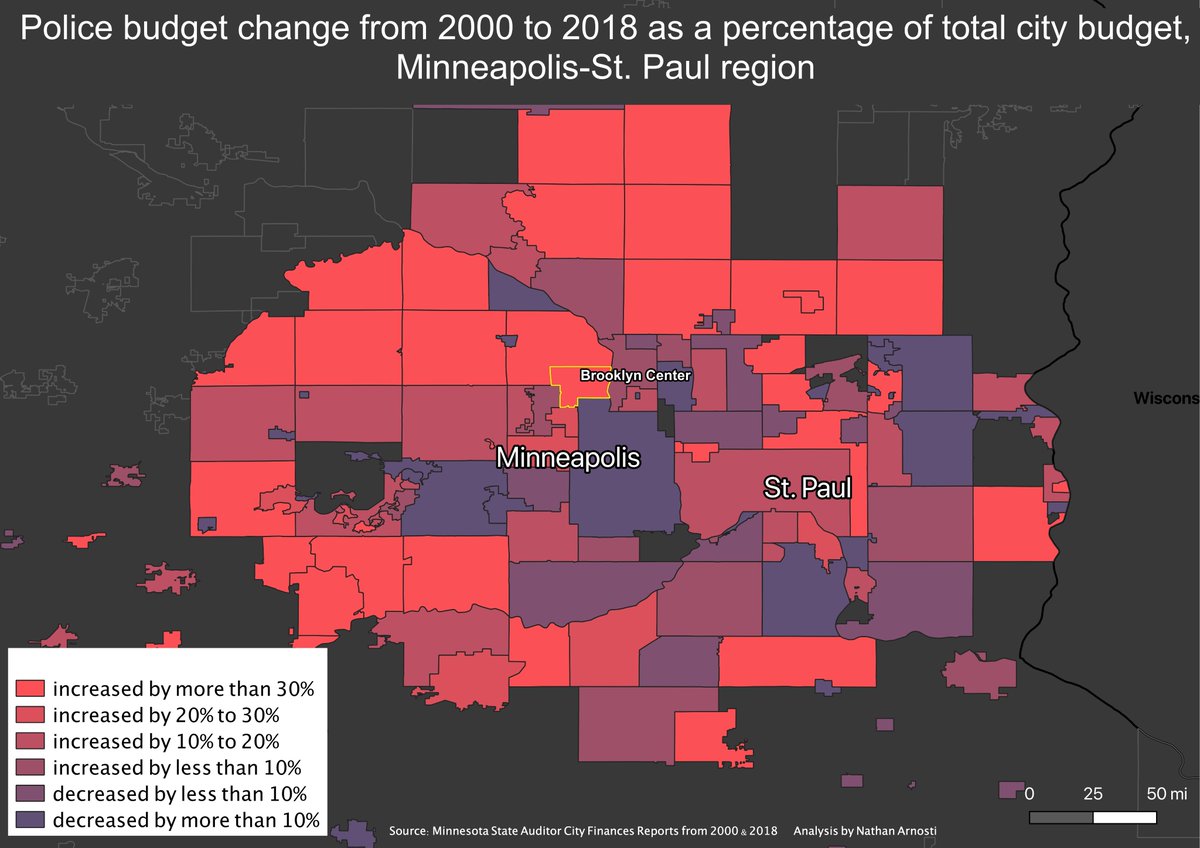
It’s this: in recent decades, it’s suburban jurisdictions like Brooklyn Center, not Minneapolis, that have seen the fastest growth in their police budgets (as a percent of the overall budget).
In 2000, Brooklyn Center spent about 29% of its non-capital budget on police. By 2018, it spent close to 40% – an increase of 31%.
But Brooklyn Center isn’t an anomaly – in fact, most suburban jurisdictions in the Twin Cities have seen double-digit % increases in police spending in recent decades. A map I made this week using data gathered for my master’s thesis reveals this spatial pattern.
Brooklyn Center spends about $270 on policing for every resident in the city – much less than Minneapolis ($412) or St. Paul ($369), but more than nearby suburbs like Golden Valley ($251) or St. Louis Park ($203).
By contrast, Brooklyn Center spends about $87 per resident on parks, and $65 on economic development. Like many other suburban cities, spending on policing far surpasses most other budgetary line items.
I’ve seen commentary on how inner-ring suburbs like Brooklyn Center have become more ethnically diverse. What I haven’t seen is any mention that these changes have been accompanied by a rapid reallocation of the city budget towards policing.
To be clear, I don’t have an answer for how much a suburb like Brooklyn Center *should* spend on public safety. That answer depends on many forms of knowledge I lack – chief among them the views of residents who are most harmed by current systems, like Daunte Wright and his family.
But I do think it’s past time we recognize that the problems with public safety aren’t just a Minneapolis problem, or even a big-city problem. These are regional & statewide & national problems. They need transformative solutions at each of these scales.
Having conversations about how your city invests in public safety and other priorities seems like a good place to start.
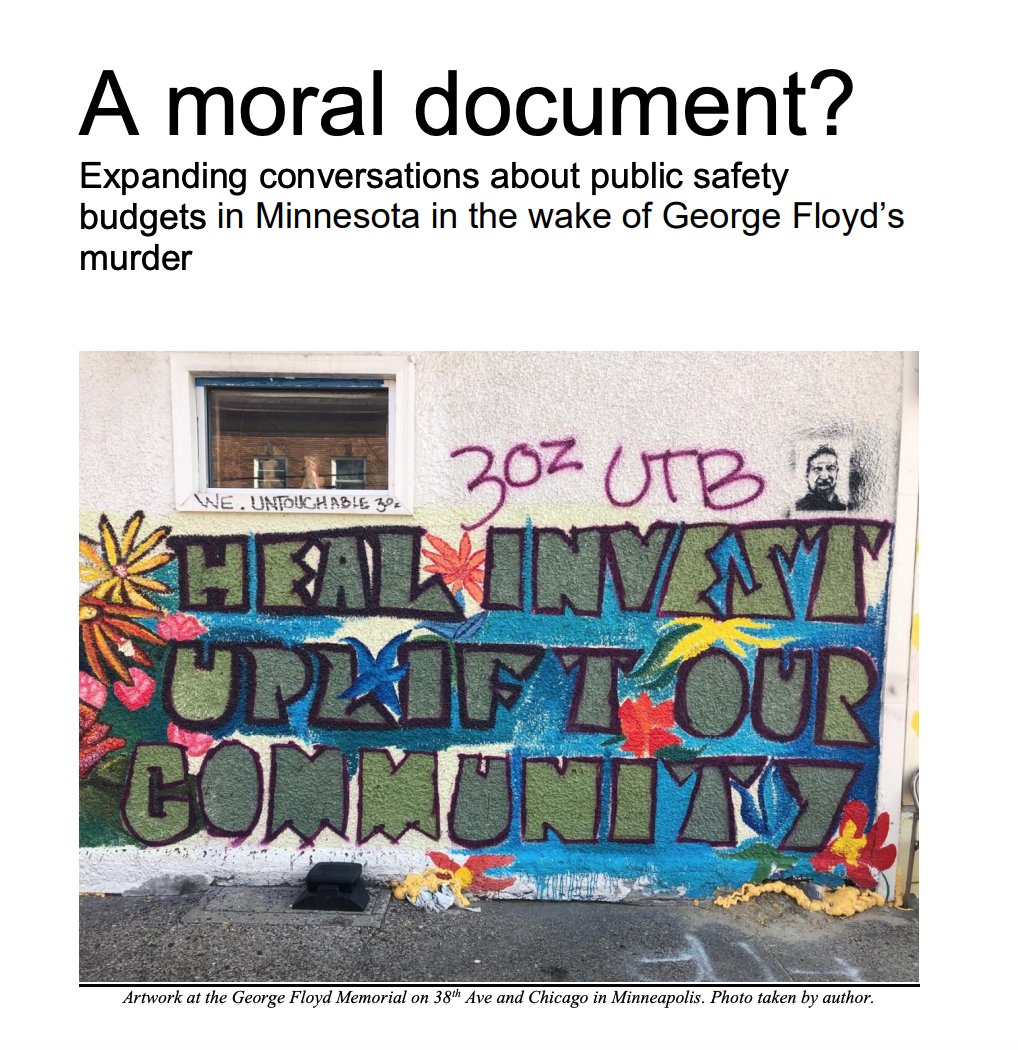
For more on how to start conversations about public safety and understand the conversations already underway, I’ll point you to my thesis, which contains ideas from leaders in Minnesota and elsewhere who know these issues far better than I do.
I want to talk about one aspect of structural racism that I don’t think privileged people like me talk about enough: the role that our social and professional networks play in giving us the jobs and opportunities we have.
With the exception of directly hiring people, there might not be a professional activity I’ve felt more personally conflicted about since graduating from college than informational interviews. On one hand, I love meeting new people, finding common interests, and learning about others’ career experiences (or sharing my own), and find that these conversations open up new career possibilities. On the other, I recognize that our society’s reliance on personal connections to make hiring decisions gives privileged, well-connected people a leg up and excludes many others from jobs they are qualified for.
A bit of context about why I’m writing about this…
I have benefitted enormously from professional networks
Somewhat regularly, I speak with friends of friends, students at my alma mater, and others about my experiences working at the Brookings Institution. Brookings tends to catch the attention of people who are looking to start careers in public policy. I didn’t have a particularly important role, but having worked there for 3.5 years as a research staffer, I got to know people across the Institution and became pretty well-versed with how the place functions.
In most conversations, I share some version of my own path to Brookings. I want to be truthful about how people get jobs in my field, and think that it’s often more helpful to share specific, personal stories than to try to sum up universal principles about job hunting from my very limited vantage point (though I feel confident in saying that it’s always a good idea to spell the organization’s name right…)
Here’s what I tell people about my own path to Brookings:
I moved to DC without a job, a privilege I could take thanks to Raffie having one and the knowledge that my parents would be able to loan me money if I needed it.
I started talking with as many people I could, including people in my college network, people from my high school, parents’ friends, and others they would introduce me to.
One of these people was a friend from college who worked at Brookings. She put me in touch with a colleague of hers, who met me for coffee. He put me in touch with another colleague, who also got coffee with me.
Around the same time, I applied for the position that I’d eventually be offered.
This third-degree connection knew the hiring manager for my eventual job, and put in a good word for me. Brookings has an extended interview process that all candidates go through, but this kind of recommendation likely moved my application from the general pool to the shortlist of candidates who get initial interviews, which would have improved my chances significantly.
It’s worth noting that everyone in this chain of conversations was white. The people I spoke with were roughly my age, had gone to expensive colleges like I did, and had many other similar life experiences as I had. We genuinely bonded and found plenty of interesting things to talk about, but I have no doubt that these connections were easier given our similar backgrounds.
It seems clear to me that only a fraction of people could have been hired in the way I was, which to me raises troubling questions about the ways that our society makes job opportunities available. But my story isn’t unique – this sort of reliance on personal connections is the norm, not the exception.
Most American workers rely on professional connections to find jobs
Research backs up my anecdotal experiences. One survey by Pew found that about two-thirds of recently hired Americans relied on personal or professional connections, and about 1 in 5 said it was their “most important resource” for finding a job.
Figure 1: Most Americans used personal or professional connections in their last job search
Source: Pew Research Center, 2015
And the field of public policy is especially dependent on networking. LinkedIn research revealed that 1 in 4 new hires in the sector have a direct LinkedIn connection with an existing employee at their new place of work (as I did). Management consulting, finance, and tech have similarly high prevalence of personal connections. By contrast, fewer than 1 in 10 new hires in the food service, delivery, and retail sectors have personal connections with existing employees.
Figure 2: Tech, politics, and consulting rely most on employees’ personal networks; delivery services, restaurants, and retail are least reliant
Source: LinkedIn research, 2015
Any guesses as to which industries pay more? Or which group of workers tends to be safely working from home these days, and which are risking their lives to meet people’s basic needs?
The result, as many others have noted, is that fields like public policy and tech can be clubby ‘good old boy’ networks that elevate traditionally advantaged groups (namely, white men) at the expense of less-advantaged groups (such as women and Black and Hispanic workers). It’s not surprising that 85% of workers in the business, professional, and political association sector, 80% of management consultants, and 76% of workers in the grantmaking and advocacy sector are white, according to the Bureau of Labor Statistics.*
*These figures include Hispanic Americans who identify as white.
So should we get rid of professional networking entirely?
Networking in its current form undeniably reinforces privilege across generations and contributes to present-day inequalities. It undermines businesses’ efforts to create fair hiring processes. It is at the core of a complicated and largely opaque opportunity structure for our society’s most desirable occupations that leaves many people out. And ultimately, every person suffers within economic systems reliant on networking, as being surrounded by like-minded peers leads to more limited worldviews and unchecked blind spots. It seems reasonable to aspire to a world in which networking plays an increasingly insignificant role. Companies’ efforts to conduct blind application reviews, hire using skills-based testing, and refuse to consider personal recommendations during the hiring process all can be considered steps in this direction.
But it’s hard to imagine eliminating professional networking from our lives entirely – and I’m not sure we’d want to. Clearly, professional networking serves a valuable purpose: it alerts people to job opportunities that fit their skills, lets them meet others who do similar work, and helps them learn useful things about the labor market. Plus, as Yuval Harari reminds us in his book Sapiens, humans may live with space age technologies, but our genetic makeup isn’t much different from the hunter-gatherers who roamed the earth in small groups 50,000 years ago; we’re fundamentally social creatures who rely on personal interactions in nearly every aspect of our lives, work included.
Where does that leave us? Our existing networking practices deserve scrutiny, and those of us who (like me) have benefitted most from it have the most work to do. I’m no expert on these issues, but here are a few things I think we could do:
Talk more openly about networking. Be honest with yourself and others about your own career experiences; doing so can help counteract the harmful myth that success is a function of some idealized notion of ‘merit’ alone.
Seek out opportunities to connect with people who have life experiences that differ from your own. To use social capital terminology, networking too often supports “bonding” within like-minded groups rather than “bridging” between different groups. This is both inequitable and professionally limiting: in my experience, we tend to learn more and produce better work when multiple perspectives contribute. Finding the right opportunities to “bridge” can be tremendously beneficial for everyone involved.
Be willing to rethink the many unwritten rules of networking and accept others who don’t follow them. I learned professional networking social norms through my predominantly white social circles, and am mindful that these are not the only ways to approach job-seeking conversations. I’m not going to fault someone for asking about my salary or not sending me a thank-you email, for instance.
Find ways to de-emphasize personal connections in hiring processes. When hiring interns at Brookings, I deliberately ignored recommendations by friends and colleagues about specific applicants, and experimented with name-blind application reviews. There are undoubtedly many other ways to reduce bias when considering applicants.
Be very skeptical of company referral policies. Referral policies at their worst merely replicate the inequalities present in our labor market, leading companies to select from the same limited pool of disproportionately privileged candidates. Ask hiring managers how these incentive systems contribute to (or undermine) goals for a diverse workplace.
I recognize that there’s an irony to sharing this message with people within my personal network. But if you know of someone who wants to work in the policy world and wants someone to talk to, particularly if they are not a straight white guy like me, feel free to put us in touch. I’m trying to figure out a more equitable approach to professional networking, and know that I can’t do so alone. I’d be grateful for help that you can offer, and would be thrilled to have you join me in rethinking your approach to networking.
P.S. For anyone who has made it to the end of this post, I wanted to ask: Have you found any particularly good ways to broaden your network? Do you have ideas about how to pursue a career without reinforcing the old boys’ club dynamics that have perpetuated inequality?
(Originally posted as a twitter thread on January 31, 2021.)
Applying to college early decision REALLY improves your odds of getting in. My alma mater Middlebury will be accepting 34% of students who applied E.D. this year – and just 11% of students who applied regular decision. This isn’t good…
The reason is simple: applicants who apply early tend to already have advantages over peers. So accepting 3x as many E.D. applicants as regular admissions ones gives a leg up to the people who need it least. It exacerbates educational inequities.
Why do early decision applicants tend to be advantaged? First, unlike many students, they know enough by fall to apply for college. Informed parents, savvy school counselors, coaches, or private tutors can all play a role in preparing them – supports many kids don’t have.
And second, their families are well-off enough to feel ok about committing to a college without seeing a financial aid package. Students who worry about affordability & want to compare financial aid packages don’t apply E.D.
So the higher acceptance rate for early-decision students means more spots for advantaged applicants. It suggests Middlebury’s willingness to trade equity for certainty.
A few caveats: it’s worth noting that the early decision applicant pool is different from the regular decision pool – athletes apply E.D., as do students in special cohorts like the Posse Foundation – so this isn’t quite an apples-to-apples comparison.
It’s possible that early decision applicants are just extremely highly qualified. They probably are. There just aren’t enough spots at a selective liberal arts college like Midd for all the brilliant people who apply…
And Midd’s early decision isn’t just for WASP-y New Englanders. About 25% are students of color, 25% are international, & 15% are first-gen college students, per the college’s news release.
But early admitted students are more white than the student body as a whole (75% to 63%). They are almost certainly wealthier. They still collectively represent privilege.
Colleges like Middlebury provide truly amazing educational & professional opportunities, as I’ve experienced firsthand. Like any institution, operating the college requires tough tradeoffs. Maybe Midd’s inequitable admissions strategy allows other worthy efforts to happen.
But it seems at least worth asking whether there’s a better way to select a student body, one that doesn’t advantage the already-advantaged applicants and leave fewer opportunities for everyone else.
To live up to its stated value of equity, Middlebury – and other colleges like it – may need to rethink its approach to early & regular decision admissions.
For years I’ve heard about payments in lieu of taxes (PILOTs) as a promising strategy for cities to raise funds from tax-exempt organizations. What I didn’t know is that PILOTs recoup a tiny fraction of the would-be tax burden.
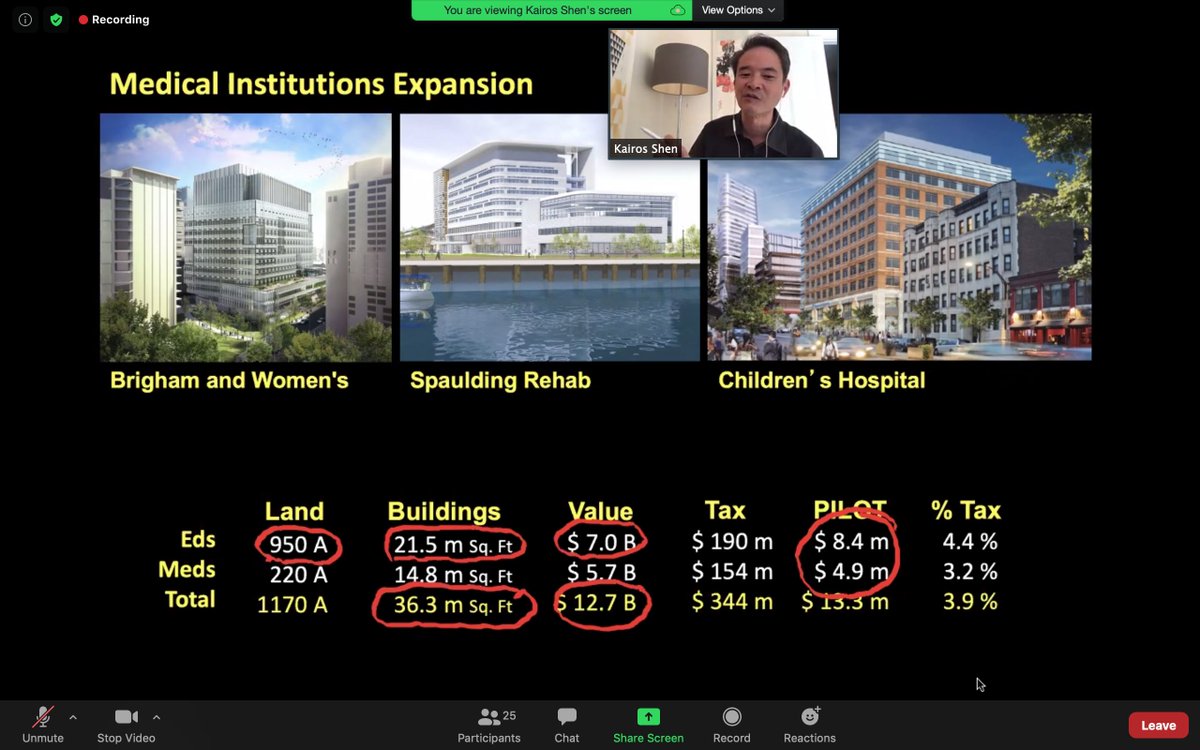
In Boston, PILOTs collect less than 5% of what taxes would. The following screenshot is from a class I took at MIT in Fall 2020 with Kairos Shen, who served as the City of Boston’s Director of Planning for thirteen years. The table at the bottom focuses on two of the largest tax-exempt sectors in the city, estimating the land value, the would-be tax burden, and the PILOTs the city collects from each sector annually. Though institutions like Emerson College and Boston University contribute $8.4 million to the city’s coffers through PILOTs, they’re paying just 4.4 percent of what their property taxes would be. And though Brigham and Women’s and the Children’s Hospital contribute $4.9 million in PILOTs, they’re paying just 3.2 percent of their property taxes.
Boston is a high-water mark for PILOTs: according to the Lincoln Institute for Land Policy, Boston collects far more money from PILOTs than any other US city.
Universities, hospitals, & other tax-exempt organizations are tax-exempt for a reason: they provide many spillover benefits to the public. But amidst COVID-induced budget shortfalls & powerful calls for new social investments, it’s worth considering whether they should pay more.
To channel my former Brookings colleague Vanessa Williamson, you know what’s better than PILOTs? Paying taxes.
I had a fascinating, hour-long conversation with a 36 year old Venezuelan-American man in Georgia yesterday who is adamantly opposed to voting for Democrats. We didn’t see eye-to-eye on a lot of issues but we had a respectful exchange, and I think his perspective is one progressives like me should grapple with.
A few takeaways:
The man’s experience of seeing Venezuela’s decline and fleeing the country with his family made him hostile to progressive rhetoric around taxing the rich, nationalizing health insurance, and defunding the police. He said that he heard the same messages in Venezuela and saw how disastrous they turned out to be.
He thought of racism solely in terms of interpersonal prejudice, not in terms of discriminatory policies and practices over time (ie structural forces). Accordingly, he didn’t believe that racism really existed today, and thought that Senate candidate Raphael Warnock was being racially divisive by calling for America to ‘repent for its worship of whiteness.’
He was a big believer in the American Dream. Based on his own family’s experience, he sees America as a place where you can succeed if you work hard. He thinks poverty is a result of the wrong mindset, and blames public schools for not teaching values of perseverance and hard work to students (his kids go to public school and he coaches high school swimming).
I told him that I saw racism as not just saying racist things, but as a society that routinely gives advantages to people in some racial groups over others. I told him about how my family’s accumulated wealth over generations had helped pay for my education, and how things like highway construction and urban renewal had destroyed the assets of many Black and lower-income families. I told him that the American Dream isn’t equally available to everyone: people with Black-sounding names are less likely to be interviewed for a job and will earn less if they are hired than white counterparts with the same qualifications. I told him that given our meagre safety net and political climate, I didn’t think we were close to turning into Venezuela. I told him that as a white person, I wasn’t bothered by Warnock’s words, because this country does have a legacy of racist policies that we need to grapple with today.
At the end of the conversation, he acknowledged that he didn’t think all Democrats were crazy and that he agreed with some of their policies, even if he wasn’t voting for them. I don’t think our conversation changed either of our minds. But I do think it helped me understand what ideas resonate with people I disagree with politically. And I hope that it helped him see our society’s challenges in a more nuanced way and better understand how progressives are proposing to address them.
Dubuque’s daily newspaper wrote about the research I undertook with three other MIT grad students to document the challenges facing immigrants in the region.
The story is behind a paywall so I’ll share some thoughts here.
For context: our team planned to spend 12 days doing research in Dubuque in March, but the spread of COVID led us to cancel travel plans a few days before our flights left and research remotely.
It quickly became clear that Dubuque was entering a different reality with COVID; the unemployment rate jumped from around 3% to 12% within a few weeks & uncertainty about the virus was high. We decided to refocus our project on how COVID was affecting immigrant communities.
Thanks to our partners at the Community Foundation for Greater Dubuque, we spoke via Zoom & phone with 29 immigrants, officials, advocates, and volunteers in the region, and surveyed several dozen local businesses in March and early April.
The people we spoke with affirmed a profound reality: Dubuque's Mexican, Guatemalan, Marshallese, & other immigrant residents already faced barriers that white Dubuquers didn't, and COVID was exacerbating these divides.
Many Guatemalan residents, caught up in a broken asylum system, took informal jobs in restaurants to support themselves while waiting to receive legal work authorization. Those jobs were the first ones to go.
The Marshallese community, suffering from incredibly high rates of diabetes (rooted in America's nuclear tests in their home islands after WWII) & lacking consistent access to health care, was especially vulnerable to the virus.
Mexican residents felt discomfort speaking Spanish in public & feared that they or family members would be deported. ICE raided the nearby town of Postville a few years ago, and we heard that a local cop followed someone home after a public event and reported their address to ICE.
Many immigrants weren't citizens, meaning that they didn't have access to the federal stimulus check, unemployment benefits, and other lifelines.
Meanwhile, the services that immigrants relied on – volunteers driving them to medical appointments & immigration court, English classes, pro bono legal advice – could no longer be done in person. Most immigrants we spoke with didn't have a broadband connection at home.
Our research tried to lift up these fears and barriers to help the Community Foundation for Greater Dubuque and its partners better understand how to respond.
We recommended creating an immigrant info center to coordinate existing services; setting a goal of universal broadband subscription across the region; hiring ‘community connectors’ to help immigrants find jobs; and pushing white Dubuquers to be more accepting of their neighbors.
We also created documents to help the Foundation & others better serve immigrants:
A “how-to” guide w/ best practices for hiring immigrants
A “bold leadership” toolkit to help white Dubuquers become better allies
And fictionalized stories of immigrants to build understanding
It was a sobering experience to learn about these challenges, even through remote research, and I’m grateful to everyone we spoke with for sharing their time and expertise.
Here’s my takeaway from this research: Our immigration policies, social safety net, medical system, and approach to policing have cruelty built into them. They are failing millions of Americans. It’s on all of us to push for fundamental changes & build an equitable future.
Our full report, executive summary, and related documents can be seen here.





 nathanarnosti.com